
The Defender's Advantage
Part V. Four Parts Counted the Threat. This One Counts the Defense. Governed and Funded Well, Synthetic Biology Hands the Defender a Speed the Attacker Cannot Match.

Bottom Line Up Front
The first four parts of this series were an accounting of threat. A careful reader could finish them and conclude that the prudent move is to slow down, pull back, and contain. That conclusion is wrong, and this part argues the opposite on the evidence. The same technology that creates the threat gives the defender advantages the attacker cannot match, and those advantages are already producing results measured in lives, in industrial capacity, and in warning time.
The argument rests on a single asymmetry. An attacker has to succeed at one specific thing, in secret, and then beat detection, manufacturing, and attribution to matter. A defender does not. A defender builds general platforms that work against threats it has not seen yet. mRNA is the clearest illustration, and a candid one. It is a single platform, retargetable in days, that carried a pandemic vaccine from published sequence to clinic in about two months and now, aimed at a patient’s own tumor, is cutting cancer recurrence in a randomized trial. The COVID vaccines also exposed the platform’s hard limit against a fast-mutating respiratory virus, and this essay treats the reach and the limit as equally real. The defender’s advantage is speed and generality, not the track record of any single product. You do not have to predict the exact threat to build the response, and every dollar spent on the platform pays off against the next threat and the one after that.
The same logic runs through the other two pillars the fourth part promised this one would cover. Distributed biomanufacturing is an industrial base that produces at home when supply lines are contested, and in December 2025 the country took a real, hard step to secure it. Biosurveillance is a sensor layer that buys a week of warning for a rounding error against the cost of a missed outbreak, and it has already done exactly that. None of this is speculative. All of it is on the public record from the last twenty-four months.
Here is the part I will not soften, because the series has never softened anything. The advantage is real, and it is not self-executing. The 2025 and 2026 record is mixed. Genuine wins, the BIOSECURE Act enacted and the bioeconomy agenda advancing, sit beside decisions that cut against the advantage: the revocation of the national biomanufacturing order, and a federal retreat from mRNA that is part sound judgment about a hard target and part strategic self-harm. The United States is building the defender’s advantage with one hand and, on at least one front, spending it. Winning is a choice, and the country is currently making it and unmaking it at the same time.
Five judgments, with confidence.
I. The Asymmetry That Favors the Defender
Start with the structure of the contest, because the structure is what the first four parts left implicit. A biological attacker operates under a stack of hard constraints. It must select a target, engineer an agent to hit it, evade the synthesis screening described in Part II, staff the work with people who do not defect or make mistakes as described in Part III, manufacture at a scale that matters, deliver without early detection, and accept that attribution may bring a response it cannot survive. Each link is a point of failure, and the attacker needs all of them to hold at once.
The defender operates under the inverse logic, and it is a gift. The defender does not need to know the specific agent in advance. It needs platforms that convert whatever appears into a response: a sequencing and surveillance layer that detects the unknown, a design platform that turns a detected sequence into a countermeasure, and a manufacturing base that produces the countermeasure at scale. Those platforms are general by construction. The same “read and write life” capability that makes Parts I through IV frightening is the capability that answers them. This is why the instinct to slow down is the wrong lesson from a threat briefing. Slowing the defender does nothing to the attacker, who is not waiting for American permission, and it forfeits the one structural advantage the defender holds, which is that its investments compound across every future threat while the attacker must start each plot from the beginning.
I assess with moderate to high confidence, about 76 out of 100, that properly governed and funded, synthetic biology gives the defender a structural advantage over the attacker in speed and generality. The confidence is not higher because the advantage is conditional in exactly two words, governed and funded. Ungoverned, the platforms become the proliferation risk this series has documented. Unfunded, the advantage is theoretical while the threat is not. The conditionality is the whole argument, and the sections that follow are the evidence that the advantage is real when the conditions are met, the record when they are not, and honest about where the tools fail.
II. Countermeasures at the Speed of the Threat
The sharpest illustration of the defender’s advantage, and the most argued over, is mRNA, and the core of it is a clock. A conventional vaccine is a bespoke manufacturing problem rebuilt for each pathogen. An mRNA construct holds the manufacturing platform roughly constant and changes the payload, which is a sequence. That property is what collapses the design timeline from years to weeks.
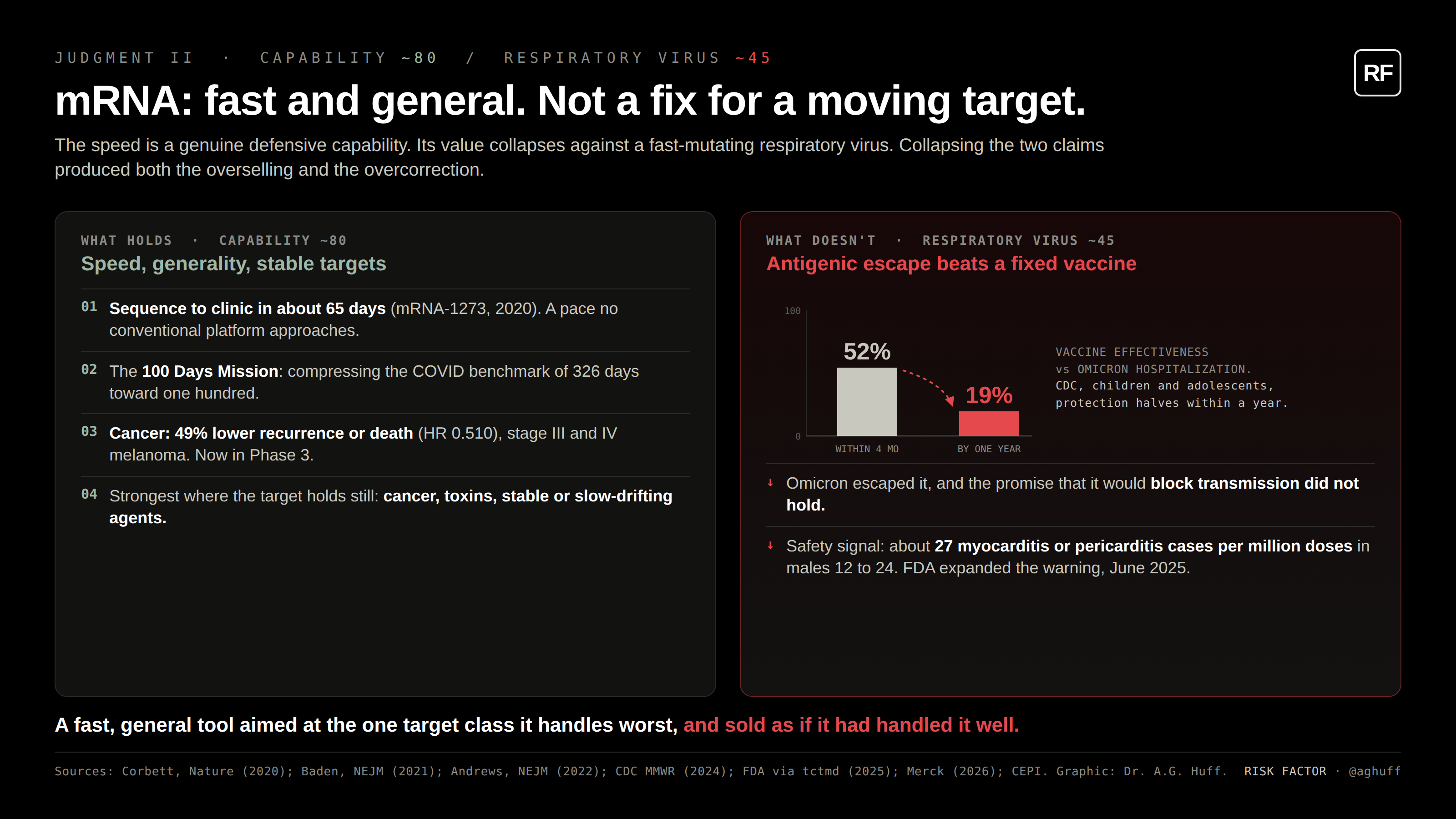
The public record on speed is specific and not in dispute. After the SARS-CoV-2 sequence was published in January 2020, the mRNA-1273 design was fixed in days and the first participant was dosed in a Phase 1 trial on March 16, 2020, roughly sixty-five days later [1]. Measured efficacy against the original strain was high in the pivotal trial [2]. That is the capability, and it is genuine: sequence to a well-matched candidate in about two months, a pace no conventional platform approaches. The COVID experience also proved the limit, and it is the limit you would name first. Against a fast-mutating respiratory virus, a vaccine fixed to one variant is chasing a target that has already moved. Real-world effectiveness fell quickly and the virus escaped it. Effectiveness against Omicron was sharply lower and short-lived [3], and CDC data in children and adolescents show protection against hospitalization falling from 52 percent within four months of a dose to 19 percent by a year, with protection against critical illness eroding on the same curve [4]. Speed of design does not solve antigenic escape. It is necessary and it is not sufficient, and a defense argument that will not say so is not worth making.
The preparedness community still treats speed as the goal, and correctly, so long as the goal is scoped honestly. The Coalition for Epidemic Preparedness Innovations frames its “100 Days Mission” against the COVID benchmark of 326 days to the first vaccines, aiming to compress that to one hundred [5]. One hundred days is decisive against a novel agent that does not reinvent its surface every season: a stable or slow-drifting virus, a bacterial threat, a toxin, where a single well-matched countermeasure can end the emergency. It is far weaker against an influenza-like or coronavirus-like target that escapes faster than a campaign can field and boost a matched product. The speed advantage is real. The error, made in the COVID response and worth not repeating, is assuming it transfers equally to every threat.
Where the platform’s promise is least contested is the target that holds still, and that is where the strongest current evidence sits. The same individualized mRNA approach is now producing oncology results. In the randomized Phase 2b trial known as KEYNOTE-942, an individualized neoantigen therapy, intismeran autogene, combined with pembrolizumab, was tested in high-risk stage III and IV melanoma after complete resection. Merck and Moderna reported five-year data in January 2026 showing a hazard ratio of 0.510, a ninety-five percent confidence interval of 0.294 to 0.887, and a forty-nine percent reduction in the risk of recurrence or death versus pembrolizumab alone, in a 157-patient trial [6]. The therapy is a synthetic mRNA encoding up to thirty-four neoantigens built to the mutational signature of an individual patient’s tumor, and the program has advanced into Phase 3 trials in melanoma and non-small cell lung cancer [6][7]. A patient’s own tumor neoantigens do not evolve to escape a campaign the way a respiratory virus does, which is exactly why this is the use where the platform’s value is clearest. That is not a niche capability. It is infrastructure.
I assess with high confidence, about 80 out of 100, that mRNA’s speed and retargetability are a genuine defensive capability, and with low to moderate confidence, about 30 out of 100, that it is the right primary tool against fast-mutating respiratory viruses specifically. Those are different claims, and collapsing them produced both the overselling of the COVID vaccines and the overcorrection now under way. The leverage is real where the target holds still: novel non-respiratory agents, toxins, and individualized therapeutics. Against a virus that reinvents its surface, the platform buys speed into a race a single product does not finish.
III. The Arsenal of Democracy, in Fermenters
Speed of design is worthless without capacity to produce, which is where biomanufacturing turns a laboratory advantage into a strategic one. Biomanufacturing uses biological processes, chiefly fermentation, to make medicines, chemicals, materials, and fuels. Its national security value is the value of any industrial base under contested logistics: the side that can produce at home, at volume, without a supply line an adversary can sever, sets the tempo. In a conflict where ocean shipping and offshore suppliers are hostile or cut off, distributed domestic fermentation is force protection.
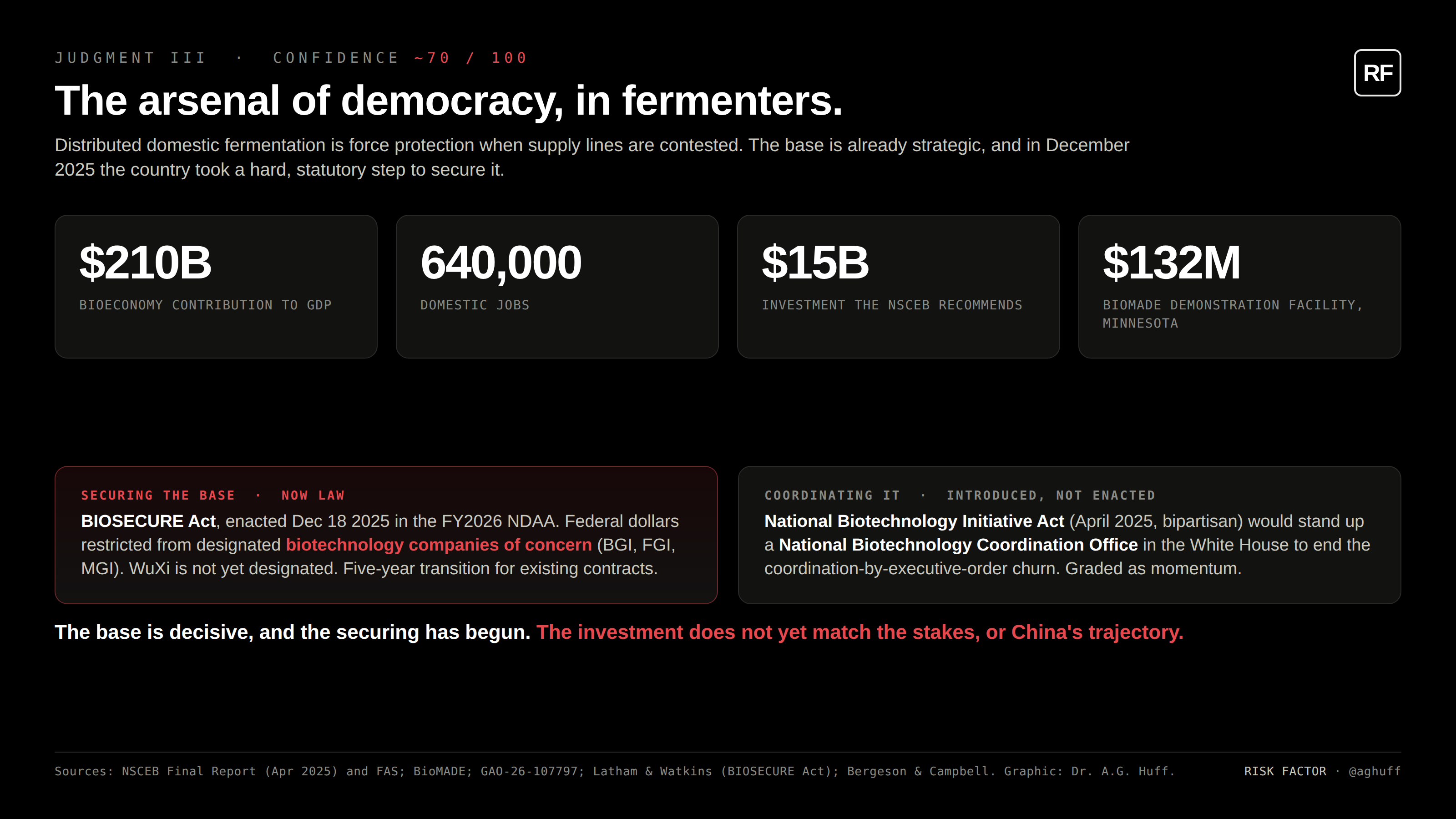
The scale is already strategic. The National Security Commission on Emerging Biotechnology, the congressionally chartered body I relied on throughout Part IV, scored the United States bioeconomy at more than 210 billion dollars of gross domestic product and more than 640,000 domestic jobs in its April 2025 final report, and recommended a federal investment of 15 billion dollars to sustain the sector as one of forty-nine recommendations built around the finding that the country is close to losing its lead to China [8][9]. The Defense Department is treating the base as a base. Through the Distributed Bioindustrial Manufacturing Program and Defense Production Act Title III authorities it has moved to build domestic capacity, and BioMADE, the Manufacturing USA institute for bioindustrial manufacturing, finalized a 132 million dollar national security investment in a demonstration-scale facility in Minnesota [10][11].
This is also the one pillar where the “lead and secure” doctrine of this series is visibly happening rather than merely being urged. On December 18, 2025, the BIOSECURE Act became law as part of the Fiscal Year 2026 National Defense Authorization Act. It restricts federal agencies from procuring biotechnology equipment and services from designated “biotechnology companies of concern,” from contracting with entities that use them, and from funding them through grants or loans, with a five-year transition for existing contracts [12]. The Act designates companies on the Defense Department’s 1260H list of Chinese military companies, currently including BGI, FGI, and MGI. I will be precise where precision matters: the major contract manufacturer WuXi AppTec and its affiliates are not yet designated, though congressional leaders have formally recommended their addition [12]. The point for this essay is not the company list. It is that the country took a durable, statutory step to reduce adversary dependence in a base it has identified as decisive, which is exactly what securing the advantage looks like. Behind it, the National Biotechnology Initiative Act, introduced in April 2025 as bipartisan and bicameral legislation, would create a National Biotechnology Coordination Office in the Executive Office of the President to end the coordination-by-executive-order churn this series has criticized [13]. It is introduced, not enacted, and I grade it as momentum, not accomplishment.
I assess with moderate to high confidence, about 70 out of 100, that distributed biomanufacturing is a decisive national security industrial base and that BIOSECURE is a real first step toward securing it. The confidence sits here, not higher, for two reasons developed in the Red Team: the economic figures blend a broad bioeconomy with the narrower security-relevant core, and BIOSECURE carries near-term costs and enforcement questions that its enactment does not resolve. The direction is right. The distance remaining is large.
IV. Seeing the Threat First
The cheapest pillar returns the most per dollar, which is why it is both the best buy and the most politically exposed. You cannot defend against what you cannot see, and modern genomic surveillance has made seeing dramatically cheaper and faster than it was a decade ago. Biosurveillance is the sensor layer for the entire threat space, natural and deliberate alike, and it is the layer that starts the defender’s clock.
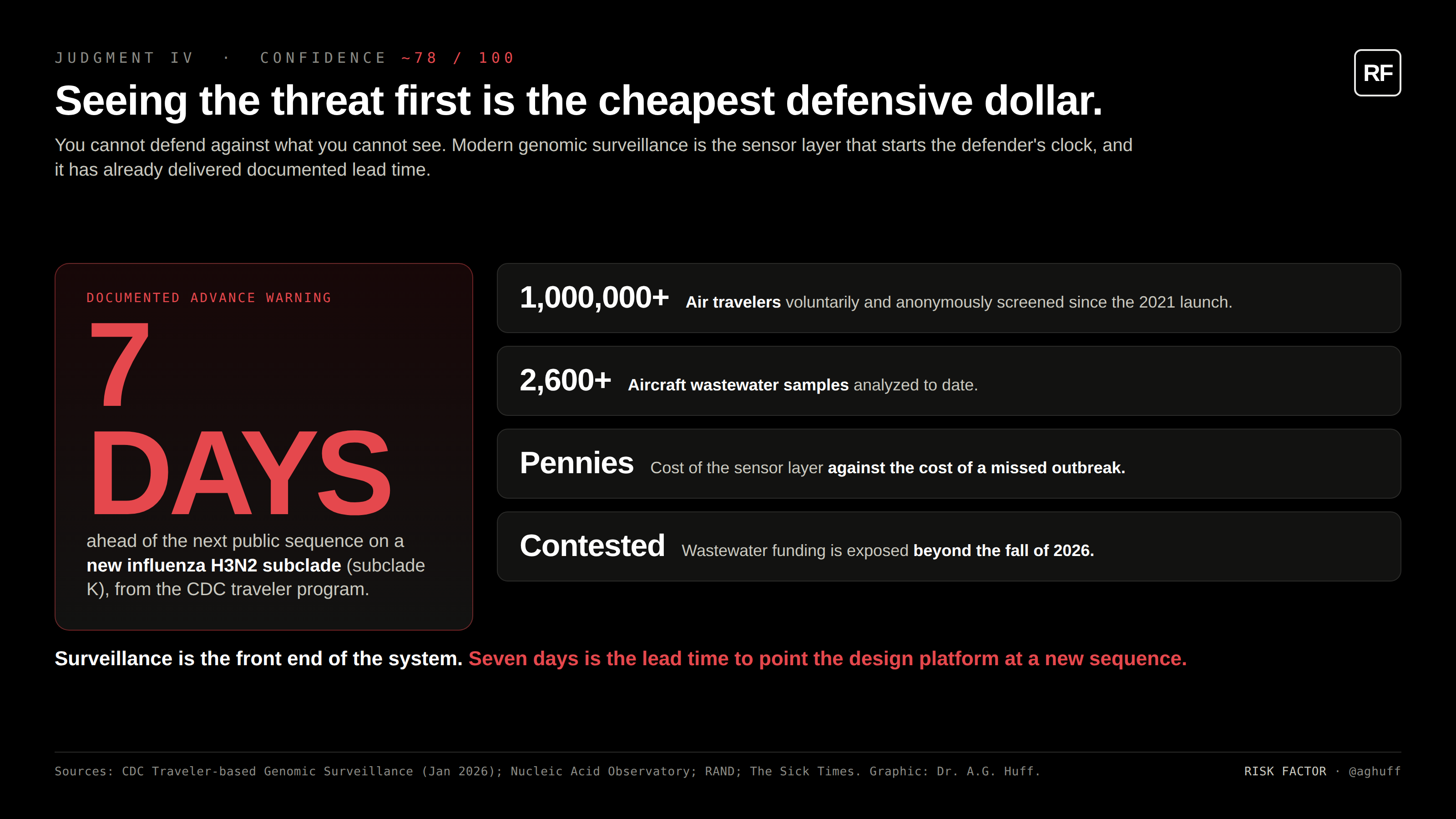
The proof points are current and concrete. On January 30, 2026, the Centers for Disease Control and Prevention announced that its Traveler-based Genomic Surveillance program, which voluntarily and anonymously samples arriving international air travelers, had surpassed one million participants since its 2021 launch [14]. This is not data collection for its own sake. The program reported the first two public detections of a new influenza H3N2 subclade, subclade K, to public repositories seven days ahead of the next reported sequence, and it has analyzed more than 2,600 aircraft wastewater samples [14]. Seven days of advance warning on a novel respiratory variant is the exact commodity the other two pillars need. It is the lead time to point a design platform at a new sequence and to spin up domestic manufacturing before the threat is widespread. This is the same detection philosophy as the Nucleic Acid Observatory I described in Part I, now operating at the border at national scale. The pillars are not three separate programs. They are one system, and surveillance is the front end.
I assess with moderate to high confidence, about 90 out of 100, that biosurveillance is the highest return-per-dollar defensive investment in the entire portfolio. The confidence is high because the cost-effectiveness case is clean and the operational proof, the seven-day lead on subclade K, is documented rather than modeled. It is not higher because surveillance can produce false confidence, and coverage gaps mean that the absence of a signal is not proof of the absence of a threat.
V. What Winning Is Worth
Assemble the advantage and price it. On the return side of the ledger sits a countermeasure platform that turns a sequence into a candidate defense in weeks and is strongest where the target holds still, from individualized cancer therapy to stable-target agents; an industrial base worth hundreds of billions that doubles as wartime production capacity and is now partially shielded from adversary dependence; and a sensor layer that buys a week of warning for pennies against the cost of a missed outbreak. These are not three nice-to-have programs. They are a single defensive system with a compounding return, because every investment in the platforms pays off against threats that have not appeared yet.
The magnitude is worth stating even when it can only be modeled, and even when the model flatters the tool. CEPI cites analysis from Imperial College London that achieving the 100 Days Mission for COVID could have averted on the order of 8.3 million deaths and 1.4 trillion dollars in productivity losses by the end of 2021 [5]. That is a model, not a measurement; the error bars are wide, the assumptions are contestable, and it presumes a durable, transmission-blocking effectiveness that the COVID vaccines did not sustain against a mutating virus. Treat it as an illustration of what platform speed is worth at its theoretical ceiling, not as a claim about what the COVID vaccines delivered. Even discounted heavily, and it should be discounted heavily, it points to why the capability is worth holding: against the right target, the payoff is measured in lives and money at the scale of a national emergency.
There is a final return that this series has insisted on since Part I, and it is not sentimental. The defender’s advantage lets the United States lead this technology without becoming the thing it is trying to prevent. A country that can out-detect, out-design, and out-produce a biological threat does not need to lower itself to the offense to be secure. That is why winning is worth the trouble. The alternative to holding this advantage is not a quieter, safer world with less synthetic biology in it. It is the same world, with the same technology, in which the United States is a spectator dependent on others for its countermeasures, its industrial base, and its warning. The trouble is the price of not being that country.
VI. The Honest Ledger
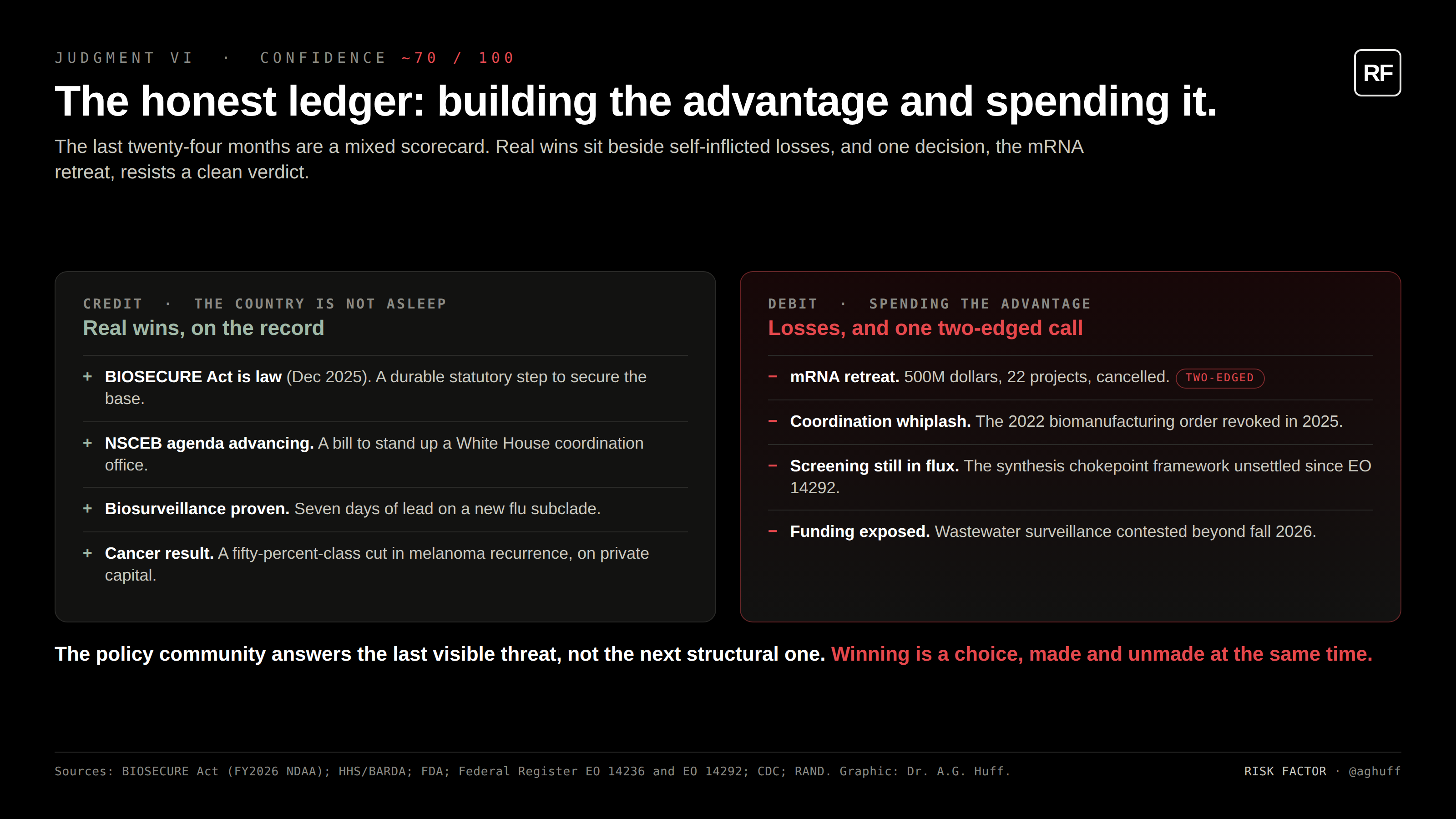
An essay that only counted the advantage would be advertising. The advantage is not self-executing, and the last twenty-four months are a mixed scorecard that a serious reader should see in full.
On the credit side, the wins are real and I have documented them above. BIOSECURE is law, a durable statutory step to secure the manufacturing base [12]. The NSCEB agenda is advancing through the National Biotechnology Initiative Act, which would end the coordination churn [13]. Biosurveillance has moved from promise to proof with the traveler program’s seven-day lead [14]. And the mRNA platform posted a fifty-percent-class reduction in melanoma recurrence, private capital carrying the science forward [6]. A country that did these things is not asleep.
On the debit side, one item is a straightforward loss and one is genuinely two-edged. The clear loss is coordination whiplash. In March 2025, Executive Order 14236 revoked the 2022 National Biotechnology and Biomanufacturing Initiative, tearing down a framework the sector had begun to build against [18][19], and the synthesis screening regime that Part II identified as the critical chokepoint remains in flux, with Executive Order 14292 of May 2025 directing yet another revision of the 2024 framework and no settled end-state on the public record [20]. The two-edged item is mRNA. In early August 2025 the Department of Health and Human Services announced it would wind down federally funded mRNA vaccine development, cancelling nearly 500 million dollars across twenty-two projects, on the stated rationale that mRNA “poses more risk than benefits for these respiratory viruses” [15][16]. That rationale is not baseless, and this essay has said why: a fast-mutating respiratory virus is a poor match for a vaccine fixed to one variant, and the safety signal was real enough that in June 2025 the FDA expanded the myocarditis warning on both mRNA COVID vaccines, citing roughly twenty-seven myocarditis or pericarditis cases per million doses in males aged 12 to 24 [17]. The cost sits on the other side: cancelling the respiratory program also thins the surge base and the domestic know-how for the platform’s stronger uses, the ones Section II defended, while a peer competitor keeps building. I do not score this as a clean self-inflicted wound, and anyone who scores it as obvious, in either direction, is not looking at both edges.
Even biosurveillance, the cheapest win, faces a contested funding picture, with some analysts warning of a wastewater surveillance funding cliff beyond the fall of 2026 while at least one source reports near-term funding secure [21][22][23]. I flag that conflict rather than resolve it. The pattern across the ledger is the through-line of the entire series, stated one last time. The policy community responds to the last visible threat, not the next structural one, and so it builds the advantage and forfeits pieces of it in the same budget cycle. The recommendation that falls out is a single sentence, and Part VI will turn it into an architecture: lead the field and secure it, invest against the threats the platforms actually handle well, and stop unmaking the advantage the country has already paid to build.
I assess with moderate to high confidence, about 70 out of 100, that the defender’s advantage is real but not self-executing, and that the United States record of 2025 and 2026 is genuinely mixed, with real gains, real losses, and at least one decision, the mRNA retreat, that resists a clean verdict. The direction of each item is firmer than the size of its net effect, and I have priced that uncertainty into the number.
VII. Red Team
The strongest attacks on this essay, stated as a skeptic would state them.
The first attack is that the whole thesis is Panglossian. Every capability I have called an advantage is dual use, and it is the same capability that made Parts I through IV frightening. A hostile reviewer says I have simply flipped the sign on the risk essays and called it optimism, and that “the defender wins if it invests” ignores that the attacker benefits from the identical maturation. I accept the framing and it is why the thesis is explicitly conditional on the words governed and funded. The claim is not that the technology is safe. It is that the defender holds a structural edge in speed and generality when the conditions are met, and that forfeiting the edge does not make the country safe, it makes it dependent. The conditionality is a limit on the argument, not a refutation of it.
The second attack goes at mRNA, and it is the one a skeptical reader, and the author of this series, will press hardest. The COVID mRNA vaccines were oversold. Their real-world effectiveness against infection waned within months, Omicron escaped them, the promise that they would block transmission did not hold, and the myocarditis signal in young men was real and took years to be fully reflected on the vaccine label [3][4][17]. A critic can argue that leaning on mRNA at all is leaning on a disappointment. I concede most of it, and it is why Section II splits the judgment rather than defending a single number. The narrower claim that survives is that the platform’s raw speed and its performance against stable targets, above all the individualized cancer therapy with its documented hazard ratio, are real and separable from the respiratory-vaccine record. The honest position is not that mRNA is a triumph or a fraud. It is that it is a fast, general tool that was aimed at the one target class it handles worst, respiratory viruses that mutate faster than a matched product can be fielded, and sold as if it had handled it well.
The third attack targets BIOSECURE, and it is the one I find most serious among the policy moves. The Act designates companies by their presence on a Defense Department list rather than by case-specific evidence of wrongdoing, which raises due-process and accuracy concerns. It imposes near-term costs on American biotechs that depend on the named Chinese manufacturers, and it may raise drug development costs or disrupt supply before a domestic alternative exists. A skeptic can reasonably ask whether it is security or security theater. My rebuttal is that reducing single-source adversary dependence in a strategic base is defensible even at a transition cost, and the five-year safe harbor is evidence the drafters understood the disruption. But I hold the BIOSECURE portion of my biomanufacturing judgment at moderate, not high, precisely because the enactment does not resolve these questions.
The fourth attack is that surveillance breeds false confidence and that my “see the threat first” claim oversells it. Coverage is partial, participation is voluntary, and a program that catches one variant seven days early can still miss the next threat entirely. Absence of signal is not safety. I accept this fully; it is why the judgment sits at 78 and not higher, and why surveillance is the front end of a system rather than a shield on its own.
The fifth attack is empirical. The 210 billion dollar bioeconomy figure blends strategically decisive capacity with commercial activity that would exist regardless of security policy, so the security-relevant core is smaller than the headline. The CEPI mortality and cost numbers are model outputs with wide error bars that assume an effectiveness the COVID record did not sustain. I have marked the modeled and blended figures as such in the text rather than laundering them into false precision, and none of the five judgments rests on a single contested number.
The unknowns are large and I will not paper over them. I do not know whether the 2025 mRNA retreat proves to be prudent triage of a weak use case or a strategic mistake that guts the surge base for the platform’s stronger ones. I do not know whether WuXi entities will be designated under BIOSECURE, or what that would cost the domestic industry in the transition. I do not know the settled end-state of the synthesis screening mandate that Executive Order 14292 set in motion, and I have said so rather than guessed. I do not know China’s true biomanufacturing trajectory with confidence, only its stated intent and visible investment. What would move these judgments is concrete and worth watching: a Phase 3 confirmation or failure of the individualized cancer therapies; whether any mRNA use proves durable against a fast-mutating target or the platform stays confined to stable ones; a durable, multiyear funding line for biosurveillance rather than an annual renegotiation; the enacted screening framework when it finally lands; and hard data, not intent, on the comparative scale of United States and Chinese biomanufacturing. Until those arrive, the direction of the defender’s advantage is firmer than its magnitude, and I have priced that gap into every number above.
This is Part V of Full Synthetic Biology. Earlier parts: the capability and the case for leading and securing; the synthesis chokepoint; the uncleared laboratory; the race.
References
1. Corbett KS, et al. “SARS-CoV-2 mRNA vaccine design enabled by prototype pathogen preparedness.” Nature, 2020. https://www.nature.com/articles/s41586-020-2622-0
2. Baden LR, et al. “Efficacy and Safety of the mRNA-1273 SARS-CoV-2 Vaccine.” New England Journal of Medicine, 2021. https://www.nejm.org/doi/full/10.1056/NEJMoa2035389
3. Andrews N, et al. “Covid-19 Vaccine Effectiveness against the Omicron (B.1.1.529) Variant.” New England Journal of Medicine, 2022. https://www.nejm.org/doi/full/10.1056/NEJMoa2119451
4. Centers for Disease Control and Prevention. “Durability of Original Monovalent mRNA Vaccine Effectiveness Against COVID-19 Omicron-Associated Hospitalization in Children and Adolescents (United States, 2021 to 2023).” MMWR, 2024. https://www.cdc.gov/mmwr/volumes/73/wr/mm7315a2.htm
5. Coalition for Epidemic Preparedness Innovations. “The 100 Days Mission.” https://cepi.net/100-days-mission
6. Merck. “Moderna and Merck Announce 5-Year Data for Intismeran Autogene in Combination With KEYTRUDA (pembrolizumab) Demonstrated Sustained Improvement in the Primary Endpoint of Recurrence-Free Survival in Patients With High-Risk Stage III/IV Melanoma Following Complete Resection.” January 2026. https://www.merck.com/news/moderna-merck-announce-5-year-data-for-intismeran-autogene-in-combination-with-keytruda-pembrolizumab-demonstrated-sustained-improvement-in-the-primary-endpoint-of-recurrence-free-survival-i/
7. Merck. “Merck and Moderna Initiate Phase 3 Trial Evaluating Adjuvant V940 (mRNA-4157) in Combination with KEYTRUDA in Certain Types of Non-Small Cell Lung Cancer.” https://www.merck.com/news/merck-and-moderna-initiate-phase-3-trial-evaluating-adjuvant-v940-mrna-4157-in-combination-with-keytruda-pembrolizumab-after-neoadjuvant-keytruda-and-chemotherapy-in-patients-with-certain-ty/
8. Federation of American Scientists. “Translating Vision into Action: The NSCEB Final Report and the Future of U.S. Biotechnology.” https://fas.org/publication/translating-vision-into-action-nsceb-final-report/
9. National Security Commission on Emerging Biotechnology. “Final Report.” April 2025. https://www.biotech.senate.gov/press-releases/nsceb-publishes-final-report/
10. BioMADE. “BioMADE Finalizes $132M National Security Investment in Demonstration-Scale Biomanufacturing Facility in Minnesota.” https://www.biomade.org/news/biomade-announces-mn-demo-scale-facility
11. U.S. Government Accountability Office. “Defense Industrial Base: DOD Efforts to Develop Domestic Biomanufacturing.” GAO-26-107797. https://www.gao.gov/products/gao-26-107797
12. Latham & Watkins. “BIOSECURE Act Becomes Law Limiting Grants With Biotechnology Companies of Concern.” December 2025. https://www.lw.com/en/insights/biosecure-act-becomes-law-limiting-grants-with-biotechnology-companies-of-concern
13. Bergeson & Campbell, P.C. “National Biotechnology Initiative Act Would Implement Recommendations from NSCEB’s Final Report.” 2025. https://www.lawbc.com/national-biotechnology-initiative-act-would-implement-recommendations-from-nscebs-final-report/
14. Centers for Disease Control and Prevention. “CDC Surpasses 1 Million Voluntary Air Travel Participants in Biosurveillance Program.” January 30, 2026. https://www.cdc.gov/media/releases/2026/2026-cdc-surpasses-1-million-voluntary-air-travel-participants-in-biosurveillance-program.html
15. BioPharma Dive. “HHS abandons mRNA vaccine research.” August 2025. https://www.biopharmadive.com/news/kennedy-mrna-vaccines-barda-hhs-cancel-contracts/756953/
16. PharmExec. “HHS Announces Reduction in mRNA Vaccine Development Programs Under BARDA, Nearly $500 Million in Contracts Cancelled.” August 2025. https://www.pharmexec.com/view/hhs-reduction-mrna-vaccine-development-barda-500-million-contracts-cancelled
17. tctmd (Cardiovascular Research Foundation). “FDA Updates CV Warnings Around COVID-19 mRNA Vaccines.” June 2025. https://www.tctmd.com/news/fda-updates-cv-warnings-around-covid-19-mrna-vaccines
18. The National Law Review. “President Trump Revokes 2022 EO on Advancing Biotechnology and Biomanufacturing.” March 2025. https://natlawreview.com/article/president-trump-revokes-2022-eo-advancing-biotechnology-and-biomanufacturing
19. Federal Register. “Additional Rescissions of Harmful Executive Orders and Actions” (Executive Order 14236). 90 Fed. Reg. 13037, March 20, 2025. https://www.federalregister.gov/documents/2025/03/20/2025-04866/additional-rescissions-of-harmful-executive-orders-and-actions
20. The American Presidency Project. “Executive Order 14292: Improving the Safety and Security of Biological Research.” May 5, 2025. https://www.presidency.ucsb.edu/documents/executive-order-14292-improving-the-safety-and-security-biological-research
21. The Sick Times. “Wastewater testing is vital for public health. It needs sustained funding to continue beyond fall 2026.” June 30, 2026. https://thesicktimes.org/2026/06/30/wastewater-testing-is-vital-for-public-health-it-needs-sustained-funding-to-continue-beyond-fall-2026/
22. RAND Corporation. “The Case for Sustaining Wastewater Surveillance Capabilities in the U.S.” April 2025. https://www.rand.org/pubs/commentary/2025/04/the-case-for-sustaining-wastewater-surveillance-capabilities.html
23. Water Online. “National Wastewater Surveillance System Funding Appears Secure For 2026.” https://www.wateronline.com/doc/national-wastewater-surveillance-system-funding-appears-secure-for-0001
Next, and last: the design. Five parts have separated the threat from the promise. The finale puts them under one doctrine, how to lead the field and secure it at the same time, written for the people who will actually have to sign the order.
Excellent series Dr. Huff, I know you are very smart, understand uncertainty in measurement, confidence intervals, collaboration in measurements, quality systems etc. simply because break each of you hypothesis in terms of a confidence interval. You have no confirmation or observational bias. Kudos ❤️🙏