
The Design
Part VI. Five parts diagnosed the threat and counted the defense. This one is the doctrine that unifies them: lead the field and secure it, in law that outlasts an administration.

Bottom Line Up Front (BLUF)
The series has done its two jobs. The first four parts showed that the threat is real, that the United States can neither ban synthetic biology nor regulate its way out of the risk, and that governance is losing ground to the technology on every axis. The fifth part showed the other half of the ledger: the same platforms give the defender a structural advantage, real where the target holds still, and the country is already spending pieces of that advantage for nothing. What is left is the hardest part, and the part every prior installment has deferred. Not another diagnosis. The design. The architecture, written for the people who will actually have to sign the order.
The doctrine is one sentence the whole series has built toward: lead the field and secure it. The failure in American biosecurity is not disagreement with that sentence. It is that the country keeps trying to execute it by decree, and decree is reversible. Nucleic acid synthesis screening, the single highest-leverage control in the entire system, has been mandated, revoked, and reordered across three executive orders in nineteen months. No adversary calibrates its program to a policy that resets with the next administration. The move that changes the game is not a better executive order. It is to codify.
This part lays out five design principles, each drawn from a prior installment, each written as something a decision maker can sign rather than a sentiment a commentator can hold: codify, do not decree; secure the chokepoint in law; vet to capability and stand up a standing institution; fund each platform to what it actually does; and enact the whole thing as a package. The BIOSECURE Act, now law, is the proof that the statutory path works. The screening whipsaw is the proof that the executive path does not.
I will be honest about what this is. It is a doctrine proposed by an analyst, not a bill scored by the Congressional Budget Office, and it depends on a Congress that just allowed the law authorizing the nation’s preparedness enterprise to lapse. I will mark where the design is strong, where it is contestable, and where it rests on political will that the 2025 to 2026 record does not obviously support. The claim is not that this is easy. It is that the pieces already exist, and the failure is one of assembly.
Five judgments, with confidence.
I. What the Series Proved
Set the foundation in one paragraph each, because the design has to answer all of it at once.
Part I established the two edges: the capability that makes synthetic biology dangerous is the same capability that makes it valuable, so neither prohibition nor retreat is available, and the uncleared laboratory is a standing liability. Part II identified the synthesis chokepoint as the highest-leverage control in the system, the one point where a screen can catch a dangerous construct before it is built. Part III showed that the people are a control surface too, and that the vetting regime keys to the wrong thing. Part IV widened the frame to the great power competition and the governance gap, including threat vectors, material targeting among them, that no current mechanism even evaluates. Part V counted the defense and told the truth about it: the platforms win where the target holds still, they are oversold where it does not, and the country is retreating from the parts that work.
The through line across all five is a single pathology, named in every part and worth naming once more. Technology outruns governance because the United States governs by the last visible threat and through instruments that the next administration can erase. The design has to answer three questions that the diagnosis only posed: what to build, what to secure, and how to make either one survive a change of government. The rest of this essay is that answer.
II. Principle One: Codify, Do Not Decree
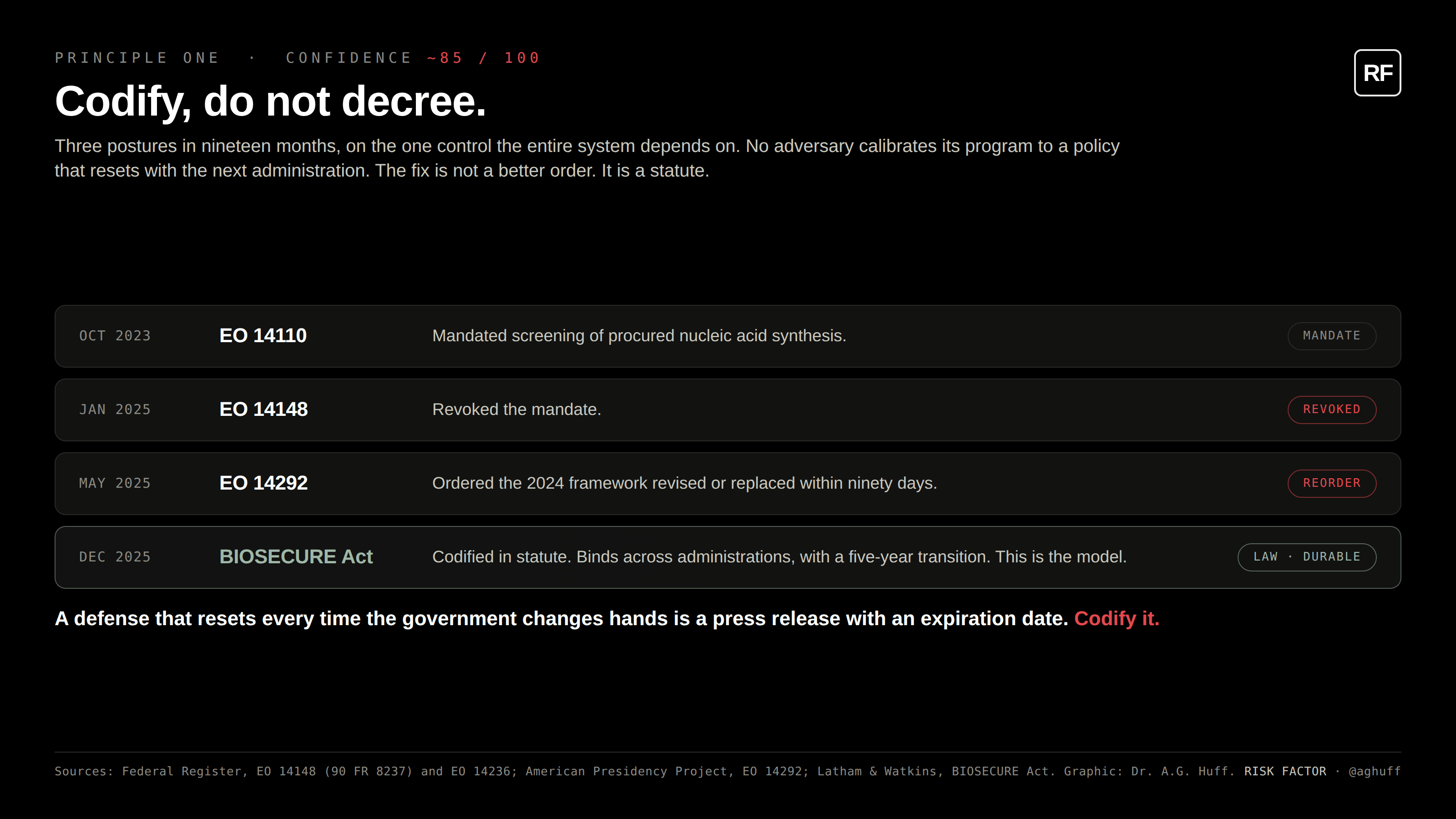
Start with the structural failure, because it undoes everything else. In October 2023, Executive Order 14110 mandated screening of procured nucleic acid synthesis. In January 2025, Executive Order 14148 revoked it. In May 2025, Executive Order 14292 ordered the Office of Science and Technology Policy to revise or replace the 2024 screening framework within ninety days [1][2]. Three postures in nineteen months, on the one control the entire system depends on. The same instrument revoked the 2022 biomanufacturing initiative in the same window [3]. A defense that resets every time the government changes hands is not a defense. It is a press release with an expiration date.
The fix is not a better order. It is a statute. The BIOSECURE Act became law on December 18, 2025, inside the Fiscal Year 2026 National Defense Authorization Act, and it will bind across administrations in a way no executive order can; its five-year transition for existing contracts shows that a statute can be durable and practical at the same time [4]. The National Biotechnology Initiative Act, introduced in April 2025 with bipartisan and bicameral sponsors, would put the coordinating function in law rather than in an order the next president rescinds on the first afternoon [5]. Codification is not a preference for process. It is the difference between a posture an adversary must plan around for a decade and one it can wait out for an election cycle.
I assess with high confidence, about 95 out of 100, that durable biosecurity governance requires statute, and that governing this domain by executive order has already failed on the documented record. The confidence is high because the evidence is not a forecast. It is the last nineteen months.
III. Principle Two: Secure the Chokepoint, in Law
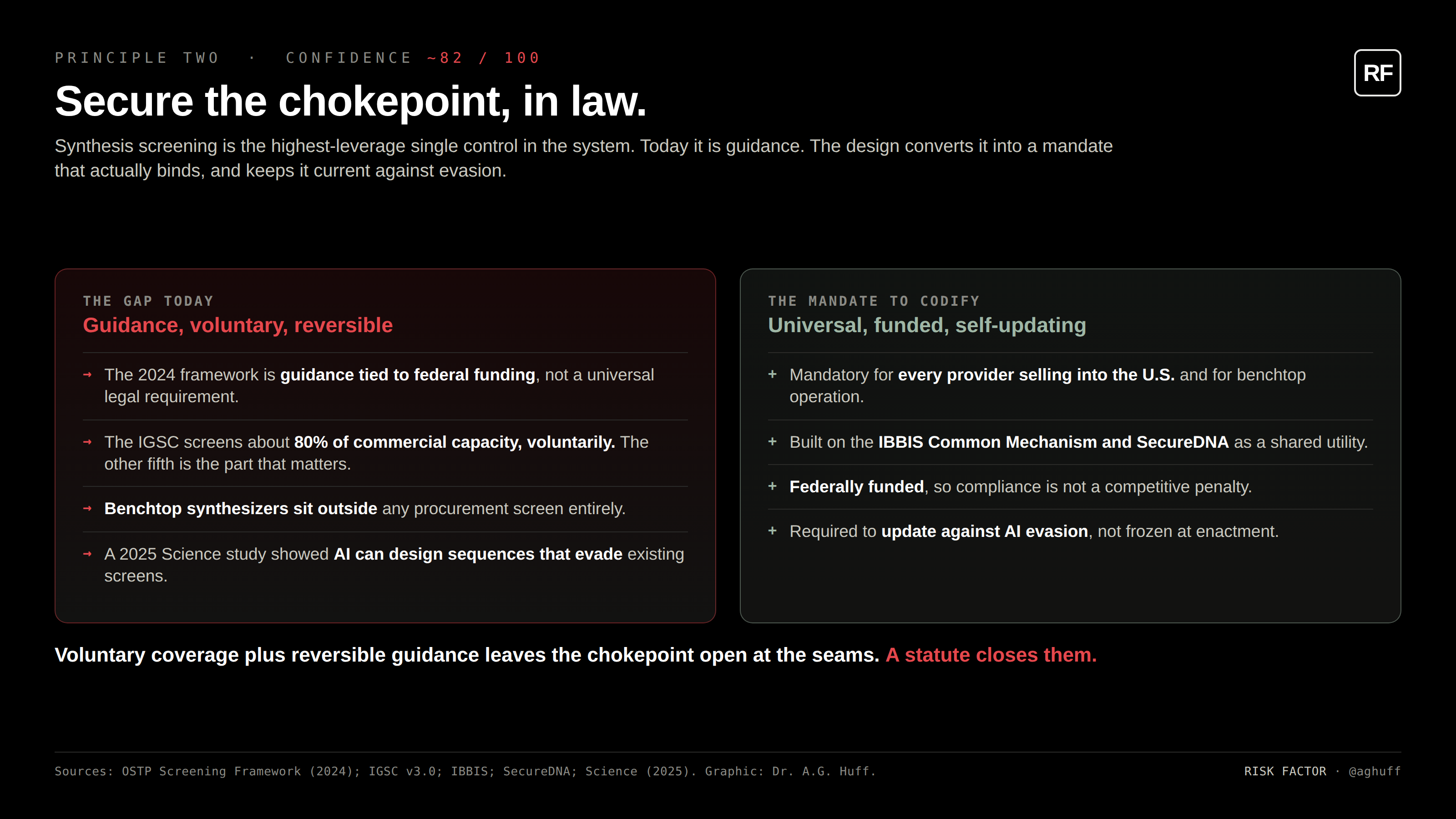
Part II made the case that synthesis screening is the highest-leverage single control in the system. The design has to convert that finding into a mandate that actually binds. Today it does not. The 2024 framework from the Office of Science and Technology Policy operates as guidance tied to federal funding, not as a universal legal requirement [6]. The International Gene Synthesis Consortium screens on the order of eighty percent of commercial synthesis capacity, but it does so voluntarily, which means the remaining fifth is the part that matters most [7]. Benchtop synthesizers, which move production inside the laboratory, sit outside any procurement screen entirely. Independent analysts have catalogued the resulting implementation gaps in detail [8]. Executive Order 14292 ordered the framework revised, but a revised framework is still an executive product: reversible, partial, and unenforceable against a provider that simply declines to participate [2].
The design is specific. Codify mandatory screening for every provider selling synthesis into the United States and for the operation of benchtop synthesizers, with the Common Mechanism maintained by IBBIS and the SecureDNA system as the technical backbone so that compliance is a shared utility rather than a bespoke cost [9][10]. Fund the screening so that doing it is not a competitive penalty against providers who do not. And build in the one lesson from Part I that a static rule will miss: a 2025 study in Science showed that artificial intelligence can design protein variants that slip past existing screens, and the patch came fast because the screening consortium could update the mechanism. A statutory mandate must require screening that is maintained against that kind of evasion, not frozen at the moment of enactment.
I assess with high confidence, about 82 out of 100, that a mandatory, universal synthesis screening requirement codified in law is the highest-leverage single move available, and that the current arrangement of voluntary coverage plus reversible guidance leaves the chokepoint open at exactly the seams an adversary would use.
IV. Principle Three: Vet to Capability, and Stand Up the Institution
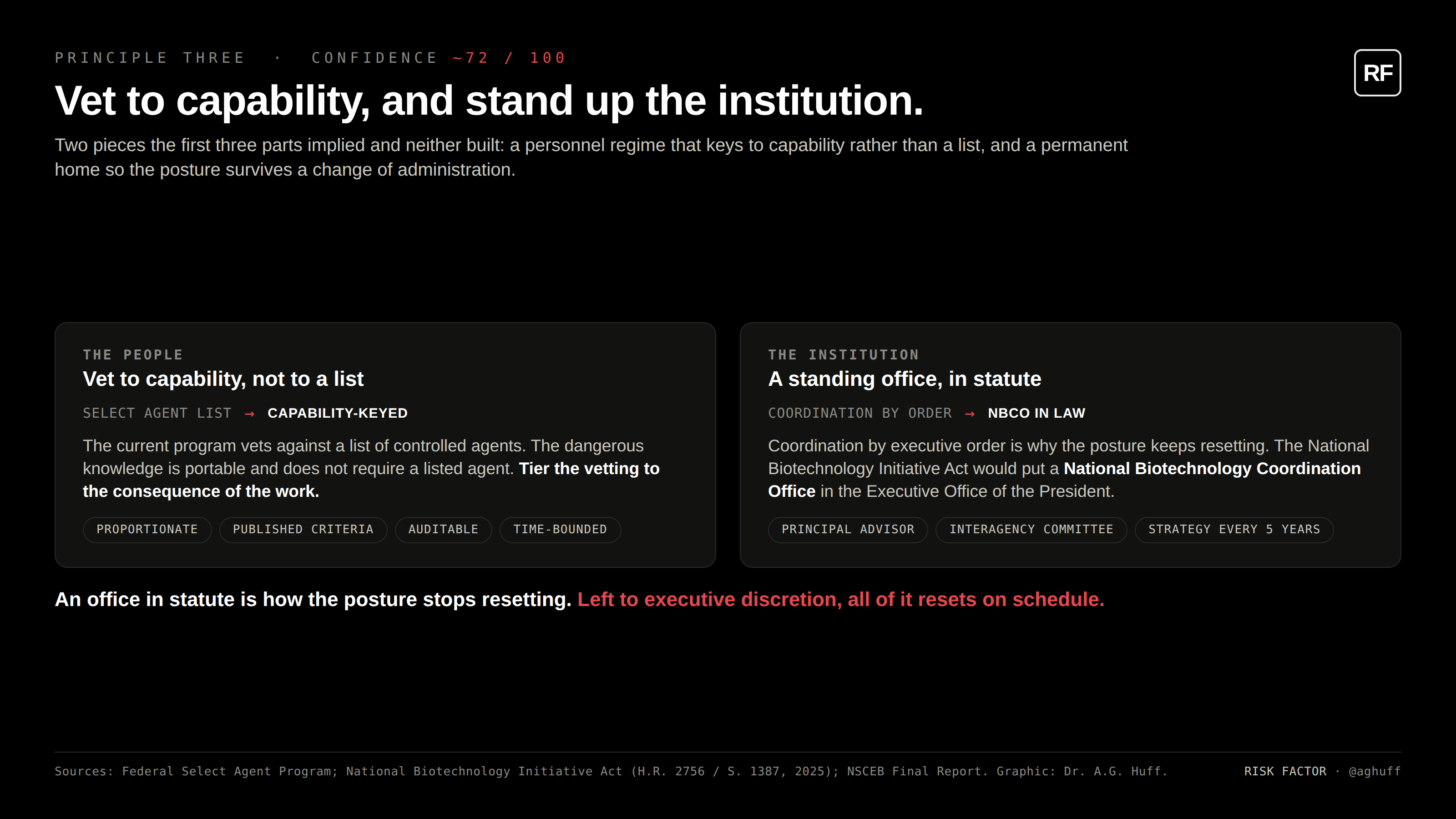
Two pieces that the first three parts implied and neither built. First, the people. Part III showed that the Federal Select Agent Program vets against a list of controlled agents rather than against the capability a person actually holds, which is the wrong key in an era when the dangerous knowledge is portable and the dangerous work does not require a listed agent. The design is a tiered, capability-keyed vetting regime for the highest-consequence work: proportionate to the risk, published in its criteria, auditable in its application, and time-bounded, not a blanket clearance system that drives talent offshore and calls the exodus security.
Second, the home. None of this survives a change of administration without an institution to carry it, and coordination by executive order is precisely why the posture keeps resetting. The National Biotechnology Initiative Act would establish a National Biotechnology Coordination Office in the Executive Office of the President, with a principal advisor to the President, an interagency committee, and a national biotechnology strategy refreshed every five years [5]. Put in statute, that office is where screening, vetting, funding, and the novel-vector review of Part IV are coordinated and kept current. Left to executive discretion, all of it resets on schedule.
I assess with moderate to high confidence, about 72 out of 100, that capability-keyed vetting and a standing statutory institution are necessary conditions for the rest of the design to hold. The confidence sits below the first two principles because both are hard to execute without either regulatory capture or bureaucratic sprawl, and a coordinating office that only adds a layer is worse than none.
V. Principle Four: Fund the Defense to What It Actually Does
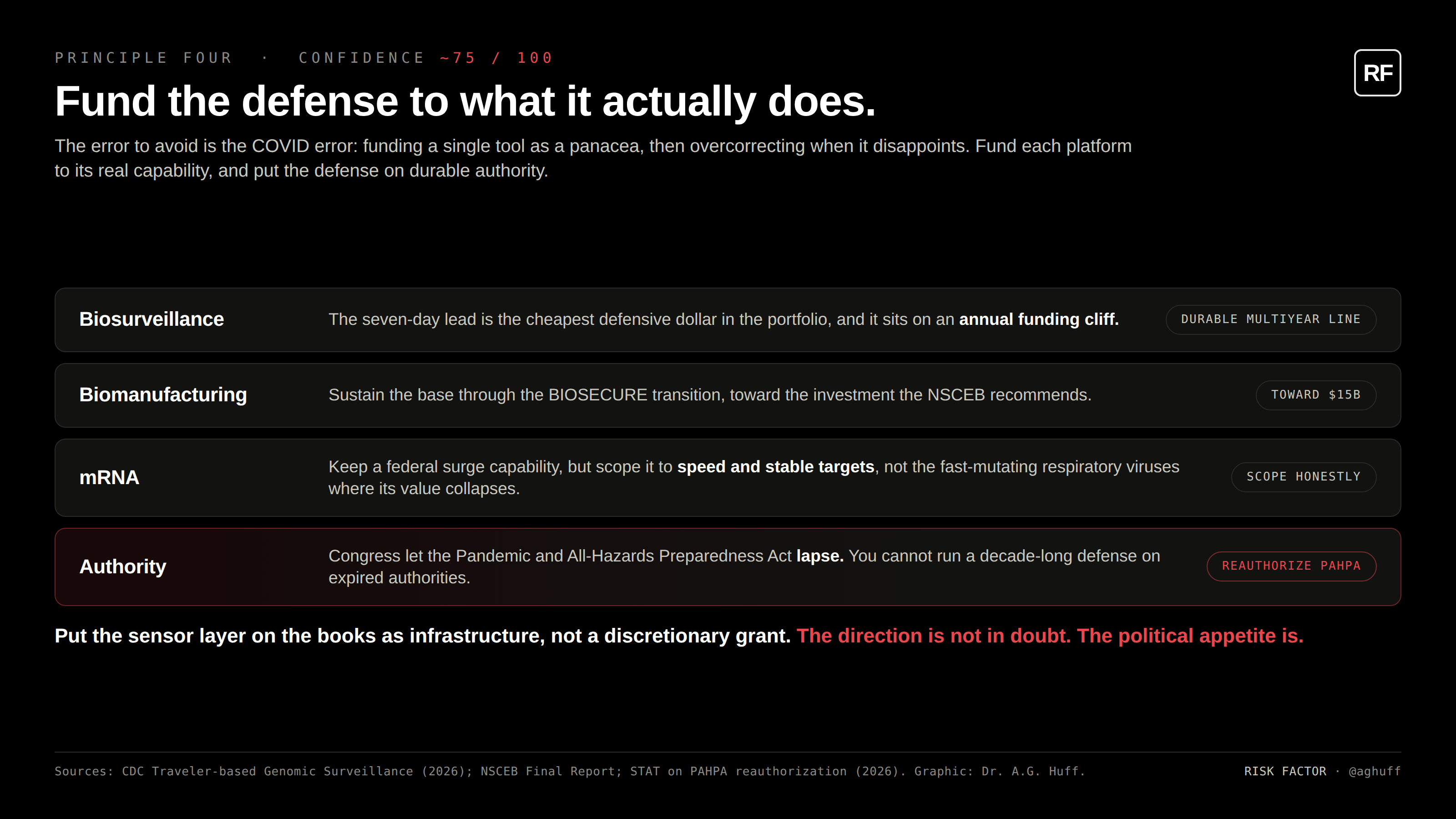
Apply the honesty of Part V to the budget. The error to avoid is the one the COVID response made: funding a single tool as a panacea and then overcorrecting when it disappoints. Fund biosurveillance with a durable, multiyear line, because the seven-day lead on a novel influenza subclade is the cheapest defensive dollar in the portfolio and it currently sits on an annual funding cliff [11]. Sustain the biomanufacturing base through the BIOSECURE transition and toward the fifteen billion dollars the National Security Commission on Emerging Biotechnology recommended [12]. Keep a federal mRNA surge capability, but scope it honestly to what the platform does well, speed and stable targets, rather than to the fast-mutating respiratory viruses where Part V showed its value collapses.
Durable funding requires durable authority, and here the record is damning. Congress has allowed the Pandemic and All-Hazards Preparedness Act, the statute that authorizes much of the federal preparedness enterprise, to lapse, and reauthorization remained unfinished into 2026 despite broad calls to act [13]. You cannot run a decade-long defense on annual appropriations and expired authorities. Reauthorize the enabling statute, fund the sensor layer as infrastructure rather than as a discretionary grant, and stop treating the defense as something to be renegotiated every fiscal year against its own evidence of value.
I assess with high confidence, about 80 out of 100, that funding each platform to its real capability, and placing the defense on durable multiyear authority, is both affordable relative to the stakes and currently not being done. The direction is not in doubt. The political appetite is.
VI. The Order, in One Page
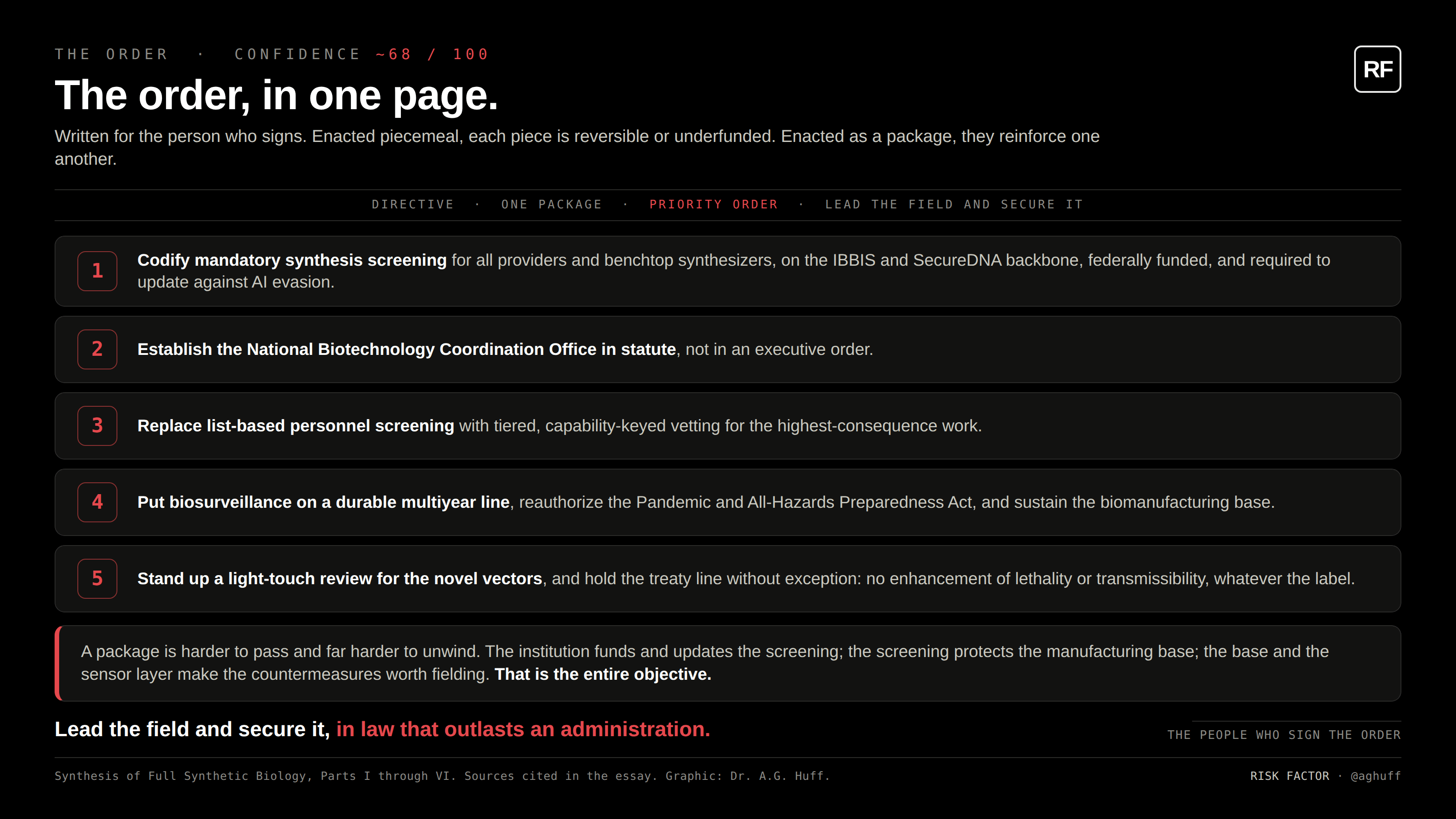
Written for the person who signs, because a doctrine that stays five essays is worth nothing. The design is worth something only as one integrated package, in priority order:
1. Codify mandatory nucleic acid synthesis screening for all providers and for benchtop synthesizers, on the IBBIS and SecureDNA backbone, federally funded, and required to update against artificial-intelligence evasion.
2. Establish the National Biotechnology Coordination Office in statute, not in an executive order.
3. Replace list-based personnel screening with tiered, capability-keyed vetting for the highest-consequence work.
4. Put biosurveillance on a durable multiyear line, reauthorize the Pandemic and All-Hazards Preparedness Act, and sustain the biomanufacturing base.
5. Stand up a light-touch review for the novel vectors, material targeting, mirror life, and the artificial-intelligence and biology convergence, and hold the treaty line without exception: no enhancement of lethality or transmissibility, whatever the label on the program.
The integration is the point. Enacted piecemeal, each item is reversible or underfunded, and the advantage gets spent the way Part V’s ledger showed it being spent. Enacted together, the pieces reinforce one another: the institution funds and updates the screening, the screening protects the manufacturing base, and the base and the sensor layer are what make the countermeasures worth fielding at all. A package is harder to pass and far harder to unwind, which is the entire objective.
I assess with moderate to high confidence, about 75 out of 100, that leading the field and securing it is achievable and affordable relative to the stakes, but only if it is enacted as an integrated statutory package rather than as a sequence of reversible parts. The confidence is capped deliberately. The binding constraint here is not technical feasibility, which is high. It is political will, and a Congress that let its preparedness statute lapse has not yet shown it.
VII. Red Team
The strongest attacks on the design, stated as its opponents would state them.
The first attack is that this is regulatory overreach that will strangle the field the country is trying to lead. It is a real risk, and the design has to answer it structurally: the mandate must be narrow, the screening federally funded so it is not a tax on the compliant, and the burden audited by independent technical experts. Mandatory screening paid for as a shared utility is less burdensome than the two alternatives that arrive if it fails, a patchwork of conflicting state laws or a punitive crackdown after an incident.
The second attack is that statute is too slow and too rigid for a field that moves this fast, that an executive order adapts in weeks and a law in years. Partly conceded. The answer is to codify the durable mandate, that screening exists, that the office exists, that the authorities are funded, while delegating the technical specifics that must move quickly to rule-making the office can update. Codify the what; delegate the how. That is how every functional regulatory statute already handles a moving target.
The third attack is that the novel-vector governance is speculative, and that Part IV said so itself. Building law around a threat not yet on the record is governing a hypothesis. Conceded, which is why that piece is deliberately the lightest in the package: a review mechanism, not a prohibition, explicitly a bet that it is cheaper to build the review before the capability than to write it in crisis afterward.
The fourth attack is that a doctrine written by a commentator is not a bill. It ignores committee jurisdictions, the budget score, the industry lobby, and the plain fact that the last screening mandate died because the politics turned against it. Conceded fully, and it is the honest limit of the exercise. The contribution here is the architecture and the priority order, not the legislative vehicle. That the BIOSECURE Act became law over the same objections is the evidence that the politics are difficult, not immovable.
The fifth attack is the one I cannot fully answer, and it is aimed at the premise. The whole design assumes a government that both wants to do this and is competent to do it, and the 2025 to 2026 record, the mRNA cancellation, the revoked biomanufacturing order, the lapsed preparedness statute, points the other way. My rebuttal is narrow and I will not inflate it: BIOSECURE passed, the coordinating office bill is bipartisan, and the biosurveillance program is delivering documented lead time. The capacity exists in pieces. The design is the argument for assembling those pieces on purpose, now, rather than having the next event assemble them under worse conditions and worse leadership.
The unknowns are large and they are the right place to end the series. I do not know whether Congress will codify screening or reauthorize the preparedness statute, or whether a new coordinating office would coordinate or merely add a layer. I do not know the settled state of the screening framework that Executive Order 14292 set in motion, and I have said so throughout rather than guess. I do not know whether the political will to build a defense survives the absence of a visible crisis, and the honest historical answer is that it usually does not. What would change these judgments is concrete: a screening statute, a funded coordinating office, a reauthorized preparedness act, or, failing all of it, the next incident, which remains the most likely and the most expensive way this design finally gets built.
This is Part VI, the final part of Full Synthetic Biology. Earlier parts: the capability and the case for leading and securing; the synthesis chokepoint; the uncleared laboratory; the race; the defender’s advantage.
References
1. Federal Register. “Initial Rescissions of Harmful Executive Orders and Actions” (Executive Order 14148, revoking Executive Order 14110). 90 Fed. Reg. 8237, January 28, 2025. https://www.federalregister.gov/documents/2025/01/28/2025-01901/initial-rescissions-of-harmful-executive-orders-and-actions
2. The American Presidency Project. “Executive Order 14292: Improving the Safety and Security of Biological Research.” May 5, 2025. https://www.presidency.ucsb.edu/documents/executive-order-14292-improving-the-safety-and-security-biological-research
3. Federal Register. “Additional Rescissions of Harmful Executive Orders and Actions” (Executive Order 14236, revoking Executive Order 14081). 90 Fed. Reg. 13037, March 20, 2025. https://www.federalregister.gov/documents/2025/03/20/2025-04866/additional-rescissions-of-harmful-executive-orders-and-actions
4. Latham & Watkins. “BIOSECURE Act Becomes Law Limiting Grants With Biotechnology Companies of Concern.” December 2025. https://www.lw.com/en/insights/biosecure-act-becomes-law-limiting-grants-with-biotechnology-companies-of-concern
5. Bergeson & Campbell, P.C. “National Biotechnology Initiative Act Would Implement Recommendations from NSCEB’s Final Report.” 2025. https://www.lawbc.com/national-biotechnology-initiative-act-would-implement-recommendations-from-nscebs-final-report/
6. U.S. Department of Health and Human Services, Administration for Strategic Preparedness and Response. “OSTP Framework for Nucleic Acid Synthesis Screening” (product of the White House Office of Science and Technology Policy, 2024). https://aspr.hhs.gov/S3/Pages/OSTP-Framework-for-Nucleic-Acid-Synthesis-Screening.aspx
7. International Gene Synthesis Consortium. “Harmonized Screening Protocol v3.0.” September 3, 2024. https://genesynthesisconsortium.org/home/igsc-harmonized-screening-protocol-v3-0/
8. Frontiers in Bioengineering and Biotechnology. “Why implementation gaps could undermine synthetic nucleic acid oversight.” 2025. https://www.frontiersin.org/journals/bioengineering-and-biotechnology/articles/10.3389/fbioe.2025.1689753/full
9. International Biosecurity and Biosafety Initiative for Science (IBBIS). “The Common Mechanism for DNA Synthesis Screening.”
https://ibbis.bio/
10. SecureDNA. “Automated, free nucleic acid synthesis screening.”
https://securedna.org/
11. Centers for Disease Control and Prevention. “CDC Surpasses 1 Million Voluntary Air Travel Participants in Biosurveillance Program.” January 30, 2026. https://www.cdc.gov/media/releases/2026/2026-cdc-surpasses-1-million-voluntary-air-travel-participants-in-biosurveillance-program.html
12. National Security Commission on Emerging Biotechnology. “Final Report.” April 2025. https://www.biotech.senate.gov/press-releases/nsceb-publishes-final-report/
13. STAT. “Congress must reauthorize the Pandemic and All-Hazards Preparedness Act.” June 16, 2026. https://www.statnews.com/2026/06/16/aspr-pandemic-all-hazard-preparedness-act-reauthorization/
Six parts, one argument. The United States can lead this technology and secure it, or it can do neither and depend on those who will. The design is on the table; the order is unsigned. That last part is not a technical problem. It is a choice, and choices in this domain are made by the people who sign.